Showing posts with label shadehouse. Show all posts

Thursday, December 23, 2021

Dreaming of a green Christmas..

 It's late December, and for the first time in a long time, the pastures are still green this late in the year. We have had some very decent rain, and the dam rose considerably. We have also been mowing some areas much more frequently. We can't really get to it all, but the areas mowed are all still green, while the majority of the land turns brown as the very tall spring annual grasses die off. We've also finished the sheep watering / solar energiser / fence supplies cart.


With the cart finished, we didn't have many more excuses to not get sheep. A breeder not far from us had some Harlequin mini meat sheep available, and we went to talk to her and see the sheep. After a couple of weeks deliberation, we decided to take the leap and give them a try. We've had the flock of five for a month now, and we have been learning how to fence a little better every day. They have learned all about electric fencing now, and so have we!


Marty and I welded the panels together after our awesome neighbour showed Marty what his look like and sold us the metal for us to weld some too. They worked to keep the sheep contained while learning about electric fencing. These young sheep were smart and learned all their lessons by day 2, so on day 3 we opened up a small area just outside the pen using 3 strands of electric fencing on the outside and 2 lines for the inner fences. When it was clear the smart sheep wouldn't attempt to cross 2 wires, we used 2 on the outside fence. Now we've moved down to the back fence, we're trialing a single line with the physical fence on the other side, and 2 wires everywhere else. So far, no sheep seems interested in escaping, they seem quite happy moving into a new area every day or more often than that if the spot is lacking in green feed.


The watering cart has been working out just fine, although it is possible to make the whole thing live and get a mighty zap. Like I said, we're learning all about electric fencing too. The sheep are getting quite comfortable with the grazing system and with us as well. We bring them edible weeds, poplar and grape leaves, wormwood branches and things from the garden. They run to us and rummage through the offerings. We also open up new areas, so in their eyes, us humans are good news. They've grown in just a month, their bellies are full and they've got energy to run and jump. They're about 6 months old.


Recently it became much more of an encumbrance to, well.. shop. We have been pairing down what we need to get from the outside world, aside from food. I am lucky to have come across the JADAM method of making liquid fertilisers. It's easily comparable to commercial fertilisers, only not as concentrated. I use it more generously too, because it costs so little to start and nothing to make, and the plants are noticeably happier as a result.
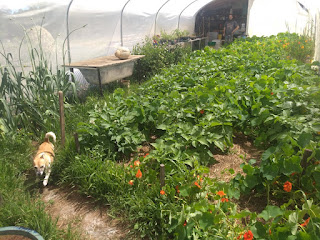


The Sebago potatoes we planted in the shadehouse back in August are mostly harvested now, and I packed the biggest potatoes in straw in a couple of milk crates. We don't have a cellar, but our kitchen does stay fairly cool thanks to the thick mudbrick walls and high ceiling. If they sprout, we'll have to re-plant them, because they do taste nice, and they are dense and firm. We have plenty of garlic and herbs, so my next plant challenge is carrots. We started eating raw carrots and drinking orange juice after listening to and reading the great Dr Ray Peat talk about their benefits. Otherwise we've been ordering our lamb directly from the butcher, saving by buying a whole carcass, and getting quite practiced in cutting up a whole lamb ourselves. We save even more by having beef or lamb heart in our stew and boiled beef kidney occasionally as well.

So we continue in our quest, at a snails pace it feels like, but even small steps are still progress, and we won't fail if we don't give up.


Monday, August 3, 2020

Annex progress & pastured chicks

Well gosh, time sure does fly by! Marty and I have been working on the annex to the shade house and the shade house itself is now covered in shade cloth and is keeping seedlings out of the frost and cold winds. We have native seedlings for planting around the farm, wattles mostly. There are tagasaste sprouting and cuttings from forage plants taking root. I intend on planting plenty of sunflowers for the poultry this season, too!


Last piece of tin for the roof!


Inspecting after a rain.


The potting bench was made last weekend from scrap and reclaimed ply-board. I painted it in a "subtle nightsky" colour, leftover from renovating the Old Miner's Cottage in Stawell. I honestly can't remember where we used that colour though!


We welded up a stand for an old laundry tub we got from a clearing sale years ago now, and it's ready for plumbing in. There's a trench cut beside the path ready for the water line, which hopefully I'll get done this week. Eventually the outside tin and roof will be painted, we tinted the paint "fairy wings" quarter, so it'll be a light pink colour!

There's still three doors to be made, a bit more shadecloth for the east side of the hoop house, and shelves to put up inside the annex, but it's all coming along. The chicken food is now stored all in one location in lockers to the south of the annex, so feeding and moving chickens is so much easier now.


The old aviary has been excellent for raising chicks. They have a little nest box where they sleep with the broody at night, and a new area to scratch up every day. I put dolomite lime down on the previous day's ground to help keep the flies away from the manure, which is also remineralising the ground as well as helping break down the old grasses.

We kept the chicks like this for just over 18 weeks, now that they're "point of lay" we popped the pullets in with the adult hens and the cockerel will soon become the best quality roast money just can't buy. :)

I really enjoyed raising the chicks like this, and will definitely do it again when one of the adult hens wants to become a mother again. The last broody happily stayed with the chicks for over 10 weeks, which is a testament to the system. Usually our hens will get sick of the chicks and smaller pen size in around 4 or 5 weeks.

So there's plenty to do, and we're working on the logistics of getting sheep so we can rotate them around the pasture as well. That won't be for a little while yet, but it's higher on the priority list now. We've measured the height of the dam wall, sized a couple of pump options and got a rough idea on what we need to get before we take the great leap forward into purchasing our first 4 legged livestock. 

Wednesday, May 20, 2020

Autumn Activity

We've had a couple of good night's sleep without the 3am microbat intrusion! We thought maybe it was getting in through the air vents, and although we'd already sealed them from the outside, I put tape over them on the inside just to make sure. Nope, that wasn't where it was getting in. While I was up on the ladder, I noticed a bit of a gap around the top of the window frame, so that was plastered over and it seems that was the answer. At least the bedroom is even more air-tight now, so there's an upside!

The brakes on the International A414 tractor are now back together and working as intended. It was the idea of lifting the back end of the tractor and adjusting the breaks while it was running was the most stressful part, but in reality it was no big issue. The old massive bottle jack and some big heavy bits of metal worked to hold her up just fine. Once adjusted, Marty took her for a run up the driveway as usual, and we discovered that the handbrake is adjustable from the top!


After the tractor was back together, we hooked up the single tine deep ripper and dragged the old A frame out from storage. We started by marking a contour line in the woodlot area using the A frame with the level attached. I then drove the tractor alongside the posts, and the deep ripper sunk into the ground, moving the soil but not turning it over. We did a rip on each side of the posts, and we planted the trees that I had waiting all summer for good weather. We planted a line of 14 trees, mostly Yellow Box and Blakey's Red Gum, in between the two ripped areas. Usually people plant IN the rip, but if it's a wet winter, they'd easily drown, so we planted them between the lines. The silty soil in the woodlot is deep and becomes a heavy clay at the bottom of the rip.

Then we took the A frame and tractor up on the top of the hill, and made a couple more contour lines up there. The soil there is rocky and hard, and the ripper didn't go in nearly as far. We hope to see some improvements to the soil and hopefully some more natives will volunteer to grow up there now. It would certainly be easier and better than buying and planting more trees and plants, but I started some locally saved seeds just to see if I can get any to come up. If they do, I'll plant them between the rips up on the hill. There is plenty more land we can rip and plant trees in, and we certainly intend to!

Since then, Marty and I have been working on a project we've had in mind for a while now, a covered annex to the shade-house. We worked on it all last weekend, and there are now 4 poles in the ground, and the ground is roughly leveled using the little Kubota. We'd planned a little garden shed in that general area, but weren't exactly excited by the plan, but we came up with a better idea and just went for it with the materials we have on hand.


The little cement mixer that Mum and Mike gave us before they went to Queensland was awfully useful. We plugged it right into the solar system, and it uses only 150W. Much quieter than running the generator for mixing a little concrete for the posts. Not to mention the bags of cement they left came in handy, too!


The next step requires some welding, and we're expecting a bit more rain, so we'll continue it when we can. It'll be such a useful little space once it's complete - a bit of storage for chicken feed, gardening supplies and tools, and shelter for potting up plants etc. It's also a bit of practice and a confidence building exercise before we start on the bigger shed we've wanted since we moved in. We'll get there!

PS: I forgot to mention how nice and easy the tractor is to drive now! It stops easily, and the handbrake works perfectly, which makes us both feel more relaxed.

Monday, October 22, 2018

Springtime 2018


In my own garden-version of no-kill cropping, I have experimented with all kinds of ways to keep from ripping weeds out of the soil, while attempting to keep my preferred plants sunlit. I find my old hand sickle far too large to use between plants. I have tried my garden knife (called a Hori hori) but it isn't sharp enough to cut grass and weeds cleanly without ripping. I then tried taking flowering seed heads off the grass with my hands. That doesn't work well when the grass lets go of the soil instead of the flower. So, I found some old grass shears that were probably in a bunch of old gardening tools, won for a few dollars at a clearing sale years ago. They're old, but in good condition, although my hand is definitely getting stronger using these shears! There's a pinch spot you have to be careful of, and a glove is useful. The cut is much nicer though, clean, and accurate. If I accidentally cut off some garlic leaves, at least I know the garlic isn't completely done for!


However, I did leave it a little late to find the best tool for the job. The grasses are flowering and dropping pollen with every snip, which makes for a sneezing, eye-watering experience. Still, everything that is cut stays where it falls, and it's fast and much easier than pulling and ripping. It's quiet, clean (no dirt flying anywhere, no dirt under my fingernails!) and I feel better not killing.
On the other hand, I understand there's a satisfaction in taking out the frustrations of life by pulling weeds, and yes, the grass are annuals and are going to die once they've flowered anyway, but this way, a living root stays in the soil as long as possible. That's the main thing. I'm going to keep going with this and see what happens.


I've been keeping the mono garlic neat and trimmed using the shears for longer than the kitchen garden beds. I simply trim back the grass around the garlic, let the grass lay where it fall, and rake the leaves and mulch back over the bed. I rake the leaves and mulch back about once a week at the moment, because the choughs are extremely diligent (but not neat) about their bug control duties.


Did I mention that I added a couple of extra hoops to the shade-house? They're a bit bigger than the original hoops, which might need to be fixed before the shadecloth goes on, but it doesn't bother me if it looks a little funny. What is funny is when birds like kookaburras or ravens or choughs try and land on the slippery hoops, wings and tail waving all around trying to keep from falling off. Well, it's either funny or I'm starting to loose it out here on my own. :)


Speaking of loosing it, I am really glad that snakes can't hear. I think they'd be offended at the scream that I let out when I see one! Honestly, I can't help myself! They're so beautiful, and after I've screamed, I usually try and get a little look at their shimmering golden brown colour. Being an Eastern Brown, I don't get closer, and every time I see one, it gets away from me as quickly as possible, which is really quick!
Almost everyone I've met around here kill snakes on sight. It's not legal, it's not ethical, it's not necessary. Well, maybe if I sprout a tail and get really small and fuzzy all of a sudden. They eat mice, not people. :p


The water tanks are about half way full. The house tank is 22,500L (5,000 gal) so, maybe 10,000L (2000 gal) full, and the structure tank (pictured above) is 10,000L, so another 5,000L (1000 gal) worth in there. The structure tank fills up faster than the house tank when it rains, and I wanted to access that water for use in the food gardens before it had a chance to overflow. I started digging the ground with a mattock to bury the water line (important as the tractors and cars drive over this spot occasionally). I found the mattock to be .. well, I'm sure you can imagine, even after a rain, the mattock makes that dull thud on the ground and little old me didn't bother doing that for too long. I found the broadfork to be an excellent tool to use instead! It went in to the soil much deeper and kept the soil in big chunks. I lay the blueline in and rolled the chunks back over the top of the pipe. Easy, even for me!


And finally, in keeping in the spirit of being nicer to the soil, I bring you seed balls version 2.0. The no-clay version.
I planted some bean seeds last month. It was a bit too cold to plant, but about 4 or 5 plants are still alive today. I re-seeded the spots that didn't make it, but this time I encased about 3 or 4 bean seeds into a ball of worm castings, and planted the whole thing. Our worm farm has been doing really well and we have enough castings to put them to good use in the garden at last. I almost can't wait to see if it works! The castings should help give them a good start, and I'm also adding dolomite to the soil around any other seedlings that I transplant. If things keep going well, and we get some more rain, we should have a really interesting growing season ahead. With all the researching, reading and educational and inspirational podcasts I've been listening to, I've been looking forward to putting it all into practice. Still, it's only spring, and when the dry, windy 40°C plus (104°F plus) weather hits, this positive attitude could very well wither and die like the grass in the paddock. Speaking of the paddock, I had read that one of the best ways to mulch (we do it with the mulching mower on the back of the tractor), is to cut it before the pollen falls from the grasses. That way, green premium hay is dropped onto the ground before the summer heat. I really enjoy "mowing", and because I cut high, and the grass isn't thick due to the lack of rain over winter, it was quite easy to do. I cut less than half the grasses, and will cut a little more soon, although I maintain quite a lot of long, wild areas to keep insects and other critters happy.

Until next time!

Monday, July 16, 2018

Green n frosty

It's that time of year again, the frost that takes out the tomatoes comes around and I have to run around with a camera taking shots of the ice covering everything. The photo below is of the stump I use to peen (sharpen) the scythe on, and the strawbales behind it.


I'm not sure the mandarin tree enjoys the frost, but it doesn't complain.


Alpine strawberries. I really hadn't considered their name until just now. I guess it makes sense that they're absolutely fine with frost! It's still flowering and looking well.


Nothing escaped the first big frost this year, not even in the shadehouse, although the effect was less in there, the plants that are not cold tolerant just keeled over. It's almost a relief when it comes to tomatoes, since I don't have the heart to pull out green plants, even if their fruit hasn't been ripening, but now that they're black, I have a good excuse. Perennials that died are just going to have to be a lesson in what I can't have here. That included a lovely little pawpaw tree, a couple of ornamental plants, and succulents. Maybe we'll get lucky and they'll live again in Spring.

Tuesday, September 26, 2017

Mega catch-up!

I haven't blogged since Marty started working in town full time. It's been a whole different routine, it takes me a while to adjust! (3 months?!)

 The frost has been a bit harsh this year. Plants that have otherwise survived many other years suffered this year. It was only a week between there being morning frosts and 30°C (86°F) weather with strong northerly winds. You have to be tough to survive that kind of thing.

I mustered up the courage to use the Kubota to dig out some more of the north of the house. It's a little scary doing things like that alone, out where no-one can hear you scream.. ok, it's not space or anything!

Using the front end loader on the tractor, I was digging down and managed to get the backhoe stuck on the higher ground and the back wheels of the tractor spinning in the air. That was a little scary! Lifting the backhoe worked, although the pins that held it in place were tight due to the force. Oops.

I was really relieved to put it away and be done with it all. Any more adjustments can be made with a shovel! The Kubota is pretty awesome and powerful, and I couldn't have done the job without it, especially with the peppercorn tree roots all over the place.

This year I'll be covering the soil with cardboard and straw to help protect the ground from storing the sun's heat. Eventually it'll be an enclosed glass house, but in the meantime it's keeping the water and soil from building up around the house.

We finally got around to making a cage like the one we had in Stawell. It's super handy for de-brooding chooks, and for caring for sick or injured ones too.

Poor old Little Roo was the first to spend time in there. I suspect she was egg bound, and this way we were able to easily administer caster oil and vitamins to her. She perked up for a while, but when it became clear that she wasn't able to pass the egg and she was getting worse again, we put her to sleep.

It's like I've heard, the favourites and named birds tend to live the shortest lives. Little Roo was a rare character, and she has place in our hearts and memories.

Then all of a sudden everything is blooming and bees are going crazy with all the flowers to choose from. The wattles and the almond trees are always first to bloom, and this year the chaenomeles went crazy too.


I have been reading the Square Foot Gardening method, and while I don't exactly have perfect square foot sections in the shadehouse, it still works, and I learned a lot from the book. I have onions at the far end, beetroot next, maybe some garlic down the left side (I found them in a seed tray which was over-run with weeds, the tag too faded to read), I have more beetroot under the fowlers jars which have just popped-up today, and some carrot seeds under the hessian which stays moist with a Wobble-Tee on a timer near-by, and the worms are loving it under there! There's just enough room to get my foot between the beds, but I can reach easily to the middle of the bed. Weeding has been easy so far, but I don't expect my luck to hold out! The running grasses are just waiting for warmer weather.

I've got 2 more beds to prepare like this, one for fruits and flowers like tomatoes and cucumber, the other for legumes like beans and maybe some peas too. They've been resting under straw since winter and should be pretty nice by now. The leafy bed has a couple of broccoli plants producing now, and a cabbage starting to get growing, and two silverbeet plants who were planted in slightly the wrong place for the system, and I would have removed them if they weren't so very tasty still. Next year I'll switch it up for crop rotation purposes. It's fairly small, but hopefully productive and manageable too.

I've been playing with irrigation in the shadehouse. I had trouble finding much information about irrigation with tank water and no pump. I already knew that Wobble-Tee was an option since I've used one before, but all my garden beds are long, not round! I decided to try a dripper hose and a low pressure garden timer. The dripper hose dribbled water in one spot, slowly dripped in a few others, and did nothing for most of the rest. In order to see if the problem was the garden timer, I plugged in a Wobble-Tee and turned it on. I tried this set-up in the kitchen garden a couple of years back with a normal mechanical timer. The Wobble-Tee didn't work at all, the timer had reduced the little pressure we get down to a dribble. No such issue this time, in fact, it worked amazing because of the slightly lower location to the kitchen garden! So, the timer is a winner, and so is the Wobble-Tee!

I've moved the drip line down to the huglebed to see if being lower again might help - but if not, I didn't spend too much money finding out at least. (It will probably be on the Permie "Giving table" soon, I imagine!) I have to run the plumbing down there next, which shouldn't be too hard, then I can test it out.

The garden tap has been replaced with a ball-valve tap to maximise the pressure and to make it easier to turn on and off. I love how it's a 1/4 turn to open and close it, especially if I've gotten distracted and the watering can is almost full. That happens more than I care to admit!

It has been a pretty dry winter here, and I fear for the summer. I have a huge list of things to do that should help keep us all a little cooler. It's my main priority now, apart from trying to keep everything going, and making life as easy as I can for Marty, who's working hard to pay for it all. :)

Shade house love

In loving appreciation for the shade house. 💚

It's more of a shade tunnel, running roughly east-west and very roughly on contour. Made with steel pipe, heavy duty electrical conduit, and the help of a few of our friends.


6m in length, with 6 hoops about 1.2m apart on each side. It's about 3.5m wide.


A star picket and a length of old wood hold up the middle of the arches on each end.

A hole is drilled into the wood for the 4 way connector to "plug" into. It's also expertly wired together (Thanks Alan!). The blue glue holds the hd conduit into the connector. We used 20mm conduit and connectors, which seem to be holding up, despite the southerly winds giving it a little lean to the north.


It took 2 separate pieces of shadecloth sewn together with fishing line to cover it. The ends are left open, although some bugs and bees get stuck on the west end, most seem to figure it out by the next morning (I think they follow the sun). A strategic hole could be made to help the critters out.

The 20mm conduit fits inside the steel bars - a hole is drilled through both and wire secures the lot.

The 50% shadecloth reduces evaporation, damaging winds and hail and softens heavy rainfall. It reduces the effects of frost (although this year was harsh and a light frost made it into the shadehouse on a couple of occasions).

If I could change anything, I'd make circular shade domes with a sprinkler in the centre. Drip lines and length-ways irrigation doesn't work well without pressure, and I find the Wobble-T to be the most effective watering system here because of that. However, the Wobble-T does work fine in this style of shadehouse (and this is easier to build and cover with shadecloth than domes would be) I just need a couple more of them!

Lastly, we've noticed that green leafy vegetables grown in the shadehouse are very delicious in comparison to the tougher leaves of the plants grown out in the extremes. I guess I also tend to spend more time watering (and weeding, feeding, talking to..) the plants in there, because it's a more comfortable environment for humans as well!